





By Aminu Adamu
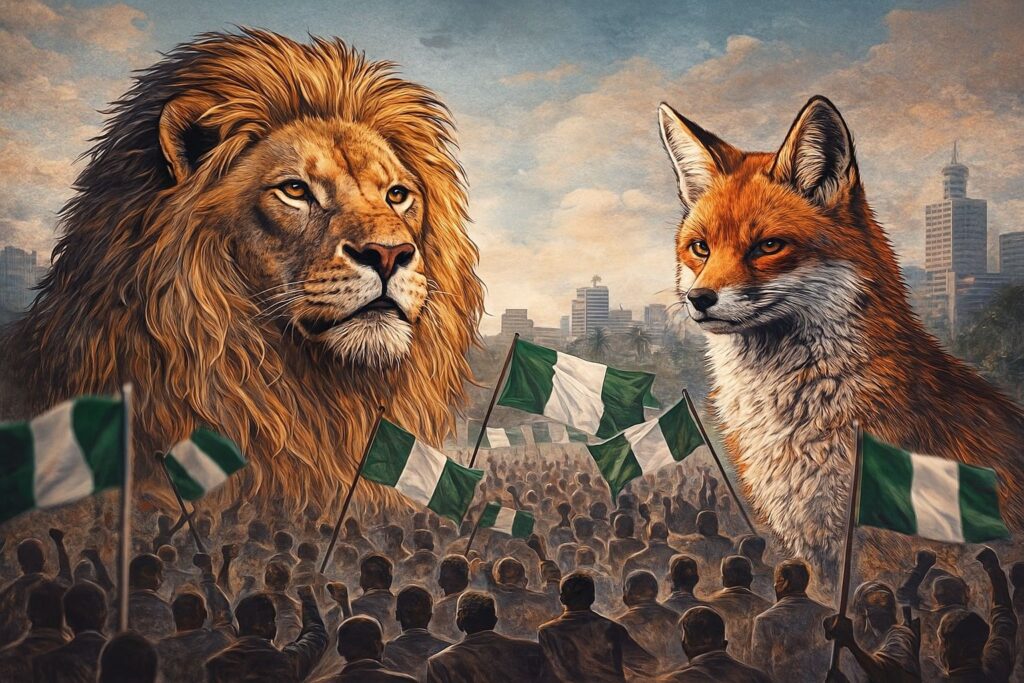
Every election cycle in Nigeria reminds us that politics here is not just a contest of manifestos or personalities. It is a constant struggle between two kinds of political actors: the strong and the cunning, the enforcers and the negotiators, the lions and the foxes.
This is not my metaphor. It belongs to Italian sociologist Vilfredo Pareto, who argued more than a century ago that every society is ruled by two types of elites. The lions rely on force, authority and rigid discipline. The foxes survive through persuasion, alliances and clever political manoeuvring. Nigeria, perhaps more than any other democracy in Africa, is living proof of Pareto’s theory.
The Government as Lion… and Fox
Whoever controls the federal government almost immediately grows lion-like. The pressures of governing a large, complex country naturally push the incumbent toward authority and order. When protests rise or security challenges spread, the government’s first instinct is often to deploy the machinery of the state security agencies, regulatory bodies, and executive power. Nigerians have seen this across administrations, regardless of political party.
But no government can survive on force alone. As elections approach, the same lion must quickly become a fox. Appointments are reshuffled. Power blocs are courted. Governors suddenly become indispensable. Party leaders travel across regions seeking endorsements. Political narratives soften. Deals multiply in the shadows.
In those moments, the ruling party behaves exactly as Pareto described: rigid lions during crises, flexible foxes when survival is on the line.
The Opposition’s Cunning
Opposition parties, lacking the levers of state power, naturally lean on fox-like tactics. Their strength lies in messaging, alliances, defections, coalition-building, and public sentiment. Nigeria’s opposition has always understood that winning power requires strategy, not strength.
The 2015 election remains the clearest example. A fragmented opposition successfully merged into a single force a masterstroke of persuasion and political calculation. It was a fox strategy executed with precision, and it changed the course of Nigerian history.
Even so, the opposition occasionally shows its lion side. After elections, especially when results are disputed, the race shifts to the courts. Here, opposition parties speak with the firmness of lions demanding strict constitutional interpretation, forensic audits, and legal remedies. In the courtroom, even foxes learn to roar.
Nigeria’s Voters and the Rhythm of Power
What makes Pareto’s framework so compelling is how it explains the behaviour of the Nigerian electorate. When fox-like elites dominate too long cutting deals, shifting alliances, or failing to deliver voters begin to crave order and decisive leadership. The call for a lion grows louder.
But when lion-like rigidity becomes too overwhelming, the hunger for fox-like negotiation returns. This cycle has repeated itself for decades. Nigeria has swung from eras of authoritative leadership to eras of flexible, coalition-driven politics, and back again.
Pareto would simply call it the circulation of elites.
A Country of Constant Rotation
Nigeria’s political system is built on compromise. No region can dominate alone, no party can win nationally without alliances, and no politician can survive without striking a delicate balance between force and persuasion. That is why the country’s political class is uniquely comfortable switching roles.
The incumbent is a lion on Monday and a fox by Friday.
The opposition is a fox in public but a lion in court.
The electorate rotates leaders when the balance becomes intolerably skewed.
This is the dance of Nigerian democracy not a straight line, but a rotation between styles of power.
The Lesson for Nigeria
Pareto’s warning is simple: societies remain stable only when leadership balances the qualities of lions and foxes. Too much force, and a nation becomes rigid. Too much cunning, and it slips into disorder. Nigeria’s challenge is not the absence of talent; it is the absence of equilibrium.
As the country moves into yet another political cycle, the question is not merely who will win, but which qualities Nigeria needs most at this moment the lion’s strength or the fox’s wisdom.
The answer, if Pareto is right, is that Nigeria needs both. And perhaps the most successful leaders of the future will be those who can roar with authority when necessary, yet negotiate with agility when the moment demands.
That is the delicate balance Nigeria’s democracy must pursue or continue dancing endlessly between lions and foxes.
