

Close Menu
The North JournalsThe North Journals

    Subscribe to Updates

    Get the latest creative news from FooBar about art, design and business.

    What's Hot

    Heat Above 40°C, Deaths Without Records How Adamawa’s Hottest Season Turned Lethal

    January 1, 2026

    Heat Stress Mortality and The Institutional Gap in Adamawa State

    January 1, 2026

    Woman killed, others injured as politician’s convoy hits tricycle in Adamawa

    December 31, 2025
    Facebook X (Twitter) Instagram YouTube
    • ABOUT US
    • WORK WITH US
    • CONTACT US
    Thursday, January 1
    Facebook X (Twitter) Instagram
    Subscribe
    The North JournalsThe North Journals
    • Home
    • Newsbeat
      • Agriculture
      • Art/Life
      • Business
      • Economy
      • Education
      • Entertainment
      • Health
      • Judiciary
      • News
      • Technology
      • Travel
      • Foreign
    • Editorial
    • Opinion
      • Diaries
    • Travelogue
    • Journals
      • Engineering
      • History
      • Law
      • Medicine
      • Politics
      • Research
      • Science
      • Climate Change
      • Psychology
      • Sociology
    • Documentaries
    • Guest Post
    The North JournalsThe North Journals
    Home » Heat Stress Mortality and The Institutional Gap in Adamawa State
    Climate Change

    Heat Stress Mortality and The Institutional Gap in Adamawa State

    The North JournalsBy The North JournalsJanuary 1, 2026No Comments3 Mins Read
    Facebook Twitter Pinterest LinkedIn Tumblr Email
    Share
    Facebook Twitter LinkedIn Pinterest Email

    By Yahuza Bawage, Abdullahi Sidi, Sakina Ahmed, Gloria Abutu, Abdulaziz Ibrahim, Ummulkulchumi Hammanadama, Aminu Adamu Ahmed, Acheli Obidah, Saddam Mohammed, Abubakar Ibrahim, and Vangawa Bolgent.

     In May 2024, Adamawa State faced a terrifying public health crisis with temperatures soaring above 40°C, and as a result of that, about 200 sudden deaths were reported across Yola, the state capital, and surrounding communities.

    Even as families mourn their loved ones, the scale of the tragedy points to a systemic failure to protect residents from the growing threat of extreme heat.

    Doctors at Modibbo Adama University Teaching Hospital (MAUTH) Yola, and the State Specialist Hospital, Yola, report that admissions increased during the hottest months, but many patients arrive too late.

    They, however, added that heatstroke, the deadliest form of heat illness, is often mistaken for malaria, dehydration, fatigue, or even spiritual affliction. And by the time families realise the severity, it is frequently too late to save lives.

    A December 2025 survey conducted by a team of journalists, researchers, and advocates in Adamawa who engaged 79 residents – including market traders, Keke-Napep drivers, households and community leaders – in Yola North, Yola South, and Girei local government areas revealed that while 96.2% acknowledged that extreme heat poses a serious risk, 75.9% could not identify the key symptoms of heatstroke, such as hot, dry, red skin or confusion. More than 73% reported personally experiencing, or witnessing a family member suffer, collapse from the heat between 2024 and 2025.

    Those whose livelihoods demand prolonged outdoor exposure, traders, drivers, food vendors, security personnel, are the most at risk, yet they are the least likely to receive formal weather alerts or health guidance.

    See also  UN Climate Body Releases New Report on AI’s Role in Supporting Climate Action in Vulnerable Nations

    Also, nearly 90% of respondents cited frequent power outages by the Yola Electricity Distribution Company (YEDC) between 12 p.m. and 4 p.m., the peak heat hours, as making the conditions “deadly.” Without electricity, fans and cooling systems fail, water becomes warm, medicines lose stability, and hospital wards become overheated. Doctors admit they sometimes fight the heat not only in their patients, but in the hospital itself.

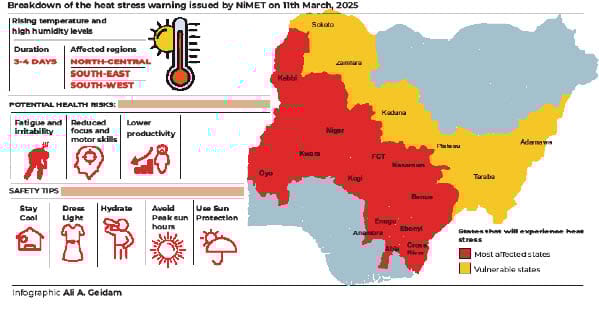
    Despite forecasts from the Nigerian Meteorological Agency (NiMet), there is no formal system in Adamawa to translate the scientific warnings into protective action.

    Experts noted that even though scientific knowledge exists, it does not reach those who need it most due to lack of unified alert strategy, local language guidance, standard messaging for outdoor workers, and there is also no standard hospital protocol for heat surges.

    The climate crisis in Adamawa intersects with economic vulnerability, and ordinary residents bear the weight more, especially drivers who are found collapsing mid-route, older people fainting in overheated rooms, mothers cradling children suffering seizures, and market vendors forced to choose between heat exposure and income.

    Now, Adamawa urgently needs a coordinated Heat-Health Action Plan, public education in Hausa and Fulfulde, stronger collaboration between NiMet, the State Ministry of Environment, the State Ministry of Health, Primary Healthcare Development Agency, and the Media, hospitals heat protocols, prioritised power supply for health facilities, structured monitoring of heat-related illness, and support for outdoor and informal-sector workers.

    Until these coordinated actions are fully taken, preventable deaths will likely continue during peak heat periods.

    Adamawa still has time to act. And that is now.

    See also  COP30 Opens in Brazil with Fresh Pressure on Countries to Deliver Climate Action


    Caveat

    This report is produced as part of the HumAngle Adamawa SCOJA Fellow advocacy activities. It aims to raise public awareness, inform policymakers, and encourage evidence-based responses to emerging climate and public health risks in the state.


    Adamawa State climate change climate vulnerability electricity outage environmental health Governance heat stress heatstroke awareness heatwave deaths hospital capacity informal workers Nigeria health system NiMet public health Yola
    Share. Facebook Twitter Pinterest LinkedIn Tumblr Email
    The North Journals

    Related Posts

    Heat Above 40°C, Deaths Without Records How Adamawa’s Hottest Season Turned Lethal

    January 1, 2026

    Woman killed, others injured as politician’s convoy hits tricycle in Adamawa

    December 31, 2025

    Kano Police Ban Fireworks and Knockouts Ahead of New Year

    December 31, 2025
    Leave A Reply Cancel Reply

    This site uses Akismet to reduce spam. Learn how your comment data is processed.

    Our Picks
    Stay In Touch
    • Facebook
    • Twitter
    • Pinterest
    • Instagram
    • YouTube
    • Vimeo
    Don't Miss

    Heat Above 40°C, Deaths Without Records How Adamawa’s Hottest Season Turned Lethal

    Climate Change January 1, 2026

    By Yahuza Bawage, Abdullahi Sidi, Sakina Ahmed, Gloria Abutu, Abdulaziz Ibrahim, Ummulkulchumi Hammanadama, Aminu Adamu…

    Heat Stress Mortality and The Institutional Gap in Adamawa State

    January 1, 2026

    Woman killed, others injured as politician’s convoy hits tricycle in Adamawa

    December 31, 2025

    Wike Accuses Fubara of Breaching Presidential-Brokered Rivers Agreement

    December 31, 2025

    Subscribe to Updates

    Get the latest creative news from SmartMag about art & design.

    About Us
    About Us

    The North Journals is a hybrid publication that combines the power of investigative journalism with the depth of research-driven analysis. Rooted in Nigeria and inspired by Pan-African realities, we tell stories that matter — stories of people, communities, and issues often left out of mainstream narratives.
    Address: Abuja, Nigeria
    Email Us: info@thenorthjournals.com

    Our Picks
    New Comments
    • Okorie Iman on INVESTIGATION: Ballard Partners: The Fixers Protecting Tinubu from Trump’s Hostilities
    • The North Journals on Breaking News: Aminu Adamu Ahmed Appointed Head of Media and Communications to ADC National Youth Leader
    • Home
    • Travel
    • Politics
    • Business
    • Buy Now
    © 2026 The North Journals. Designed by AkinMore.

    Type above and press Enter to search. Press Esc to cancel.

    Ad Blocker Enabled!
    Ad Blocker Enabled!
    Our website is made possible by displaying online advertisements to our visitors. Please support us by disabling your Ad Blocker.