





Before the Kofar Mazugal clock tower strikes three, the Jakara River is already awash in industrial poison. Night in Kano belongs to the polluters. Now, for the first time, it also belongs to the farmers fighting back.
Dawn at the Jakara: Anatomy of a Midnight Discharge
Ground Zero of Environmental Impunity
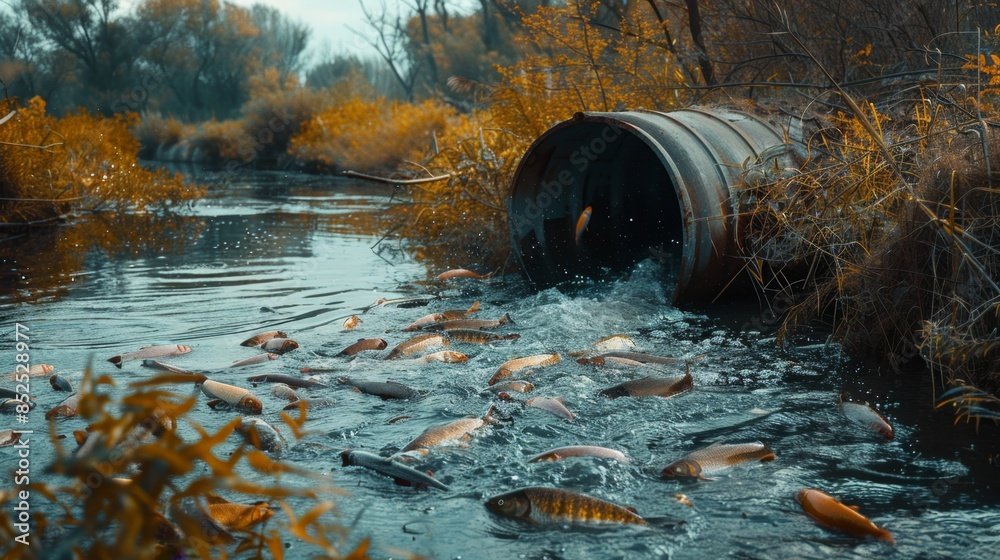
The clock tower at the Kofar Mazugal gate has not yet struck three, but the air along the Jakara River is already heavy with the weight of industrial ghosts. Night in Kano does not bring rest to the water; it brings the “midnight discharge,” a calculated choreography of environmental theft where the Bompai Industrial Estate unburdens itself of its toxic overhead under the cover of the Sahelian dark.
Malam Musa Abdullahi stands at the edge of his plot, a small rectangle of land that has sustained four generations of his family. He does not need a laboratory to tell him the river has changed. He smells it: a sharp, metallic tang, punctuated by a cloyingly sweet almond scent that sticks to the back of the throat. That scent is the calling card of cyanide and solvent-heavy textile dyes used in the factories upstream.
The Jakara, which serves as the arterial lifeline for northern and central Kano, has been repurposed as a toll-free sewer for the Bompai tanneries and textile mills. For the 5,000 hectares of active agricultural land lining this corridor, the river is the only source of irrigation. Farmers here are trapped in a lethal paradox: to stop pumping is to watch their livelihoods wither in the heat; to continue is to facilitate a slow-motion poisoning of the city’s food supply.
The factories operating behind the high walls of Bompai calculate the cost of environmental compliance and find it more profitable to externalize their waste. They rely on the silence of the water and the invisibility of the toxins. But that silence is being systematically dismantled. Through forensic auditing and community-led technology, the invisible is being rendered into data points that cannot be ignored. The water does not merely flow; it carries the metabolic waste of a broken industrial promise.
The river water is brown, and our maize tastes of chemicals. My children have stomach swelling and pain constantly. The big companies upstream act like we do not exist. They dump their filth while we sleep, and by morning, my plants look like they have been burned by a fire that has no smoke.
Mrs. Aliu, grandmother, Kadawa community
The Technical Audit: Digital Fingerprints of Industrial Theft
What the Laboratory Reveals
To understand the scale of the theft, we must move from the riverbank to the laboratory. The forensic method at the heart of this investigation is Atomic Absorption Spectroscopy (AAS), a technique that strips away the river’s murky facade to reveal the elemental truth of its composition. The 2025 lab data from the Sentinel Network reveals a landscape of chemical saturation that far exceeds international safety thresholds.
The numbers constitute an indictment. Lead (Pb) registered at 0.90 mg/L and Cadmium (Cd) at 0.13 mg/kg in soil samples are not abstract variables; they are the forensic evidence of a gutting of the environment. Lead levels in irrigation water measured nearly 180 times the permissible limit set by the FAO and WHO. Lead is a thief of cognitive potential: it crosses the blood-brain barrier and deposits itself in the bones of children who consume vegetables grown in this sludge. Cadmium, a persistent renal toxin, targets the kidneys of the urban population with surgical precision.
The science of bio-accumulation ensures that these metals do not remain in the water. They migrate. Through irrigation, the Jakara’s toxic load is deposited into the soil. The 2025 audit shows that metals including Chromium and Lead have a bioconcentration factor greater than unity, meaning spinach, tomatoes, and cabbage are actively concentrating the toxins in their edible parts. This is the ultimate transfer of wealth: the health of the citizen is traded for the profit of the polluter.
| Contaminant | Measured Level | WHO/FAO Limit | Exceedance Ratio |
|---|---|---|---|
| 0.90 mg/L | 0.005 mg/L | ||
| 0.013 mg/kg | 0.003 mg/kg | ||
| 0.082 mg/L | 0.05 mg/L |
Spinach is a hyperaccumulator. It sucks up Lead and Cadmium from the soil with terrifying efficiency. We have measured Chromium in the river silt at five times the Nigerian safety limit. This is not just pollution; it is a toxic debt that industry is taking out against the future of Kano. You cannot simply wash Lead out of your blood.
Dr. Maryam Abdullahi, Agronomist, Bayero University Kano
The Geography of Impunity: Bompai and the Invisible Walls
Inside the Regulatory Vacuum
The Bompai Industrial Estate remains the primary engine of this contamination. Established decades ago to drive Kano’s economic modernisation, it has become an island of unaccountability. The lack of functional Effluent Treatment Plants (ETPs) means that heavy metals used in tanning and dyeing operations (Chromium, Lead, and Cadmium) are dumped directly into the tributaries that feed the Jakara.
This negligence is financialised. Every litre of untreated effluent dumped represents a saved cost on a company’s balance sheet. Companies including Unique Leather Finishing and God’s Little Tannery operate in a regulatory vacuum where the supposed punishment for environmental crime consists, in practice, of an agreement not to punish at all.
The National Environmental Standards and Regulatory Enforcement Agency (NESREA) holds a clear legal mandate under the NESREA Establishment Act 2007 to impose fines and shut down offending facilities. The gap between that power and its exercise is the precise geography of impunity.
We know exactly which pipes are discharging the blue water at 2:00 AM. We have the standards. We have the laws. But there are invisible walls around those factory gates. When we try to enforce a fine, the calls come from high up. My job is essentially to document a catastrophe that I am not allowed to stop.
NESREA official, speaking on condition of anonymity
Section IV
The Action: Building the Sentinel Mesh
Technology as Environmental Justice
The silence was broken not by a government decree, but by a mesh of solar panels, silicon, and community resolve. Led by the Centre for Information Technology and Development (CITAD), the deployment of the Sentinel Network represents a decisive shift from top-down connectivity to bottom-up empowerment. This is the Community-Centred Connectivity Initiative (CCCI) in its most muscular form: technology deployed as a tool for environmental justice.
The Sentinel Mesh is an infrastructure of digital sovereignty. By establishing local connectivity in areas where commercial providers have failed or remained too expensive, CITAD has created a secure space for community data. The network consists of decentralised, LoRa-enabled (Long Range Radio) and solar-powered nodes that monitor water quality in real time. Each node acts as a relay, ensuring that the system remains resilient even if individual sensors are compromised by the harsh Sahelian environment or by the very factories they monitor.
When sensors detect a toxic spike (pH levels jumping to 12 or Electrical Conductivity hitting 3,800 microsiemens per centimetre), the system does not wait for a government report. Through the Reportrix platform, it triggers the community. Farmers along the Jakara receive an SMS alert, enabling them to shut their pumps before the most concentrated toxins can enter their soil.
How the Sentinel Network Works
- Detect: LoRa-enabled water sensors monitor pH, electrical conductivity, and heavy metal proxies 24/7 along the Jakara River.
- Transmit: Solar-powered mesh nodes relay data to the CITAD network hub without reliance on commercial telecom infrastructure.
- Alert: When toxicity thresholds are breached, the Reportrix platform sends real-time SMS alerts to 200+ registered farmers.
- Respond: Farmers shut irrigation pumps immediately, preventing peak-concentration effluent from entering soil and crop systems.
Meaningful connectivity means survival. The polluters rely on our isolation. They thrive because the data is secret. By building our own mesh network, we are stripping the mask from them. We own the sensors, we own the data, and we own the alerts.
Ali Sabo, Digital Rights Officer, CITAD
Section V
The Result: Breaking the Silence
Measuring Behavioural Change
The impact of the Sentinel Network is measured in more than data logs; it is measured in behavioural shifts and a burgeoning sense of power. The informational gap that once allowed 95 percent of farmers to remain unaware of the toxic nature of their irrigation water has been bridged. For the first time, the factories of Bompai are being watched by a decentralised, community-owned sentinel that never sleeps.
The 200 farmers along the Jakara who now receive real-time SMS alerts are no longer passive victims of the midnight discharge. They are participants in an environmental audit, co-producing the evidence base that will be used in legal and regulatory challenges to come. The steady ping of data has replaced the silence that once protected the polluters.
| Metric | Before Sentinel Network | After Sentinel Network |
|---|---|---|
| Farmer Awareness | 5% aware of heavy metal risks | 85% awareness and active participation |
| Response Time | Weeks (post-lab analysis) | Minutes (real-time SMS alerts) |
| Data Ownership | Private / factory-held | Community-owned (digital sovereignty) |
| Irrigation Behaviour | Continuous use of wastewater | Strategic use based on toxicity spikes |
The Path Forward: From Audit to Accountability
Strategic Conclusions
The forensic audit of the Jakara River reveals that environmental degradation is the physical manifestation of systemic negligence. However, the deployment of the Sentinel Network provides a replicable blueprint for resistance. The audit of impunity must now be expanded into a permanent, legal, and political force. The following strategic recommendations emerge from the data and from interviews with community leaders, scientists, and regulatory insiders.
- Scale the Mesh
Expand the Sentinel Network to the Challawa River and other industrial hubs to create a regional environmental firewall across Kano State.
- Integrate Reportrix with Legal Aid
Link real-time discharge data from CITAD’s platform to pro-bono legal groups to begin a class-action environmental audit against chronic polluters.
- Formalise the SMS Alert System
Partner with the Kano State Ministry of Agriculture to ensure every urban farmer is enrolled in the toxicity warning system as a public health requirement.
- Promote Circular Economy Solutions
Use audit data to pressure factories to invest in the 3Rs Hub (Repair, Recycle, Reuse) for chemical waste, turning toxic effluent into a resource rather than a liability.
The dawn at the Jakara no longer brings only the smell of poison; it carries the hum of a community taking its water back. The forensic fight for Kano’s rivers is not merely about cleaning a stream. It is about anchoring the city to a future where industrial profit cannot be extracted from the bodies of the poor.
The silence is broken. The audit continues.