




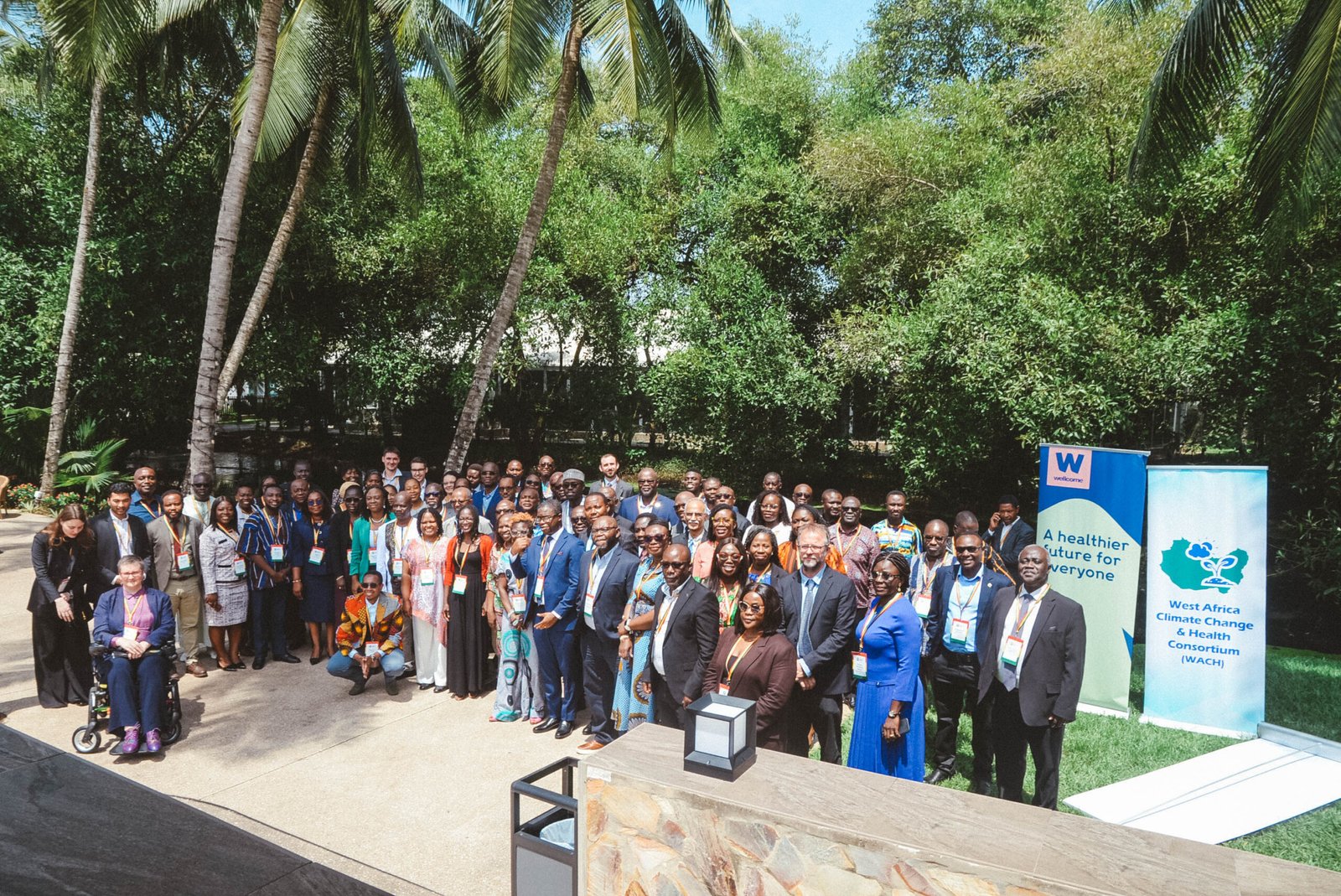
African scientists and policymakers have launched a new research partnership aimed at understanding how climate change is affecting health across the continent, from extreme heat and floods to disease outbreaks and food insecurity.
The Pan-African Climate and Health Science and Policy Consortiums were launched in Accra, bringing together institutions from West and Southern Africa to generate evidence that can guide governments in responding to growing climate-related health risks.
The initiative is supported by the Wellcome Trust, which is investing £40 million in two climate and health science and policy consortiums, one in West Africa and another in Southern Africa.
The launch brought together researchers, government officials, health experts, development partners and representatives from Ghana, Senegal, South Africa and the United Kingdom.
The partners say the aim is to ensure that decisions on climate and health are based on African evidence and reflect the realities of communities across the continent.
Africa contributes less than 4% of global greenhouse gas emissions but is among the regions most affected by climate change.
Scientists say rising temperatures, changing rainfall patterns, floods, droughts and environmental degradation are increasing health risks while placing additional pressure on already stretched health systems
Health officials at the launch said climate change is no longer only an environmental concern.
Director of Technical Coordination at Ghana’s Ministry of Health, Dr Hafiz Adams, said climate impacts are already affecting communities and health services.
“Climate change is no longer a distant environmental concern. It is a pressing public health issue and a challenge across Africa and in Ghana,” he said.
He said Ghana and other African countries are experiencing increasing risks from floods, extreme heat, droughts, air pollution, food insecurity and disruption of health services.
“These impacts place a disproportionate burden on vulnerable populations, including children, the aged, pregnant women and communities with little adaptive capacity,” Dr Adams said.
Ghana’s Ministry of Health has developed a Health National Adaptation Plan (HNAP) to integrate climate change into health planning.
Dr Adams said the plan was informed by a Harmonized Climate and Health Vulnerability and Adaptation Assessment conducted across all 16 regions of Ghana.
“This ensures that our adaptation priorities are grounded in evidence and reflect the realities of communities across the country,” he said.
The plan focuses on strengthening disease surveillance, improving early warning systems, building climate-resilient health facilities and supporting research and data-driven decision-making.
Communities need evidence they can use
Ghana’s Technical Director at the Ministry of Climate Change and Sustainability, Cedric Dzelu, said the success of the consortium would depend on producing evidence that directly supports communities.
“To simply generate data for others to interpret is not enough. You are being entrusted to co-produce evidence that speaks to our context, our informal settlements, our agro-ecological zones, disease profiles, health system capacity and our cultural practices,” he said.
Mr Dzelu said communities facing climate threats need information that can support quick and practical decisions.
“When a community in northern Ghana faces both drought and rising temperatures, cases of heat-related illness, it needs evidence that is local, evidence that is timely and actionable,” he said.
He said coastal communities facing flooding and disease outbreaks need models that can predict risks before they become emergencies.
“Science alone is not enough. The greatest gap we face is not knowledge. It is the bridge between knowledge and action,” Mr Dzelu said.
He said that bridge requires collaboration between government institutions, researchers, communities and development partners.
Climate and health challenges, he added, cannot be addressed by one sector alone.
“The floods in Accra taught us the drainage problem is also a health problem. It is also an economic problem and at the same time a climate-related problem,” he said.
Ghana leads West African climate health research
The West African arm of the consortium is being led by the Kwame Nkrumah University of Science and Technology (KNUST) in Ghana.
Director of the West African Climate Change and Health Consortium, Professor Philip Antwi-Agyei, said the initiative represents a different approach to climate research.
“This consortium seeks to produce actionable, inclusive evidence that will help us address some of the key regional climate hazards confronting us in terms of food production as well as diseases across the sub-region,” he said.
He said policymakers were involved from the beginning to ensure that research addresses real challenges.
“We started with policy-influencing institutions so that we design the generation of evidence with policymakers together with us right from the word go,” Professor Antwi-Agyei said.
Researchers will examine how climate change affects food systems, vector-borne diseases and non-communicable diseases across West Africa.
One major planned output is a predictive dashboard that will help identify possible disease outbreaks linked to changing climate patterns.
“This dashboard will help us pre-empt potential outbreaks of certain diseases and avert some of the catastrophic effects that are usually associated with climate change,” he said.
The challenges facing African communities vary from region to region. Professor Mathew Chersich who lead the Southern African Climate Change and Health Consortium said the Consortium is focusing on issues including extreme heat and flooding.
He said repeated flooding in countries such as Malawi is destroying crops, livestock and livelihoods while creating additional health challenges.
“In South Africa and Zimbabwe, extreme heat, particularly among pregnant women, has implications for the woman’s health and for newborns,” he said.
Professor Chersich said cooperation between West and Southern Africa would allow researchers to share knowledge and develop stronger solutions.
“With this Pan-African approach, we will be able to address very different issues, but complement each other’s work and together come with a cohesive message across the continent,” he said.
Africa must lead its own science
Senegal’s Director General for Health, Dr Youssouph Tine, said climate change has become one of the biggest health and development challenges facing the continent.
He said the effects are already visible through rising temperatures, floods, droughts, changing patterns of diseases, food insecurity, air pollution and water shortages.
“Climate change is no longer an environmental issue alone. It is a health issue, an economic issue, a development issue and ultimately a question of human security,” Dr Tine said.
He said no country or institution could tackle the challenge alone.
“No single ministry, no single institution, no single country can address the challenge alone. It demands coordinated action across sectors and across borders,” he said.
Dr Tine said Africa must strengthen its ability to produce and use its own scientific knowledge.
“For too long, the knowledge, data and models that guide decisions concerning our continent have been produced elsewhere. Today, we are changing that narrative. Science must not simply be produced in Africa. Science must be led by Africa,” he said.
Global partners support African-led solutions
The Wellcome Trust said the investment in the consortiums is aimed at strengthening Africa’s climate and health research capacity.
Head of Capacity and Field Development at Wellcome Trust’s Climate and Health team, Modi Mwatsama, said Africa faces some of the greatest impacts of climate change despite contributing little to global emissions.
“Africa is one of the regions of the world most affected by climate change and has contributed the least to the problem,” she said.
She said the investment would help generate evidence designed around African needs.
“We are making this investment to boost the generation of climate-actionable climate and health evidence which is relevant to the needs of Africans,” she said.
The United Kingdom also expressed support for continued cooperation with Ghana.
Health Advisor at the British High Commission in Ghana, Dominic Farrell, said the UK has worked with Ghana on climate and health initiatives, including vulnerability assessments, adaptation planning and climate-health statistics.
“The UK has really taken a lot of time to try and put some acceleration under this agenda, starting with our COP26 presidency, where we launched the Climate and Health Programme,” he said.
He said the new consortiums would help connect research with policy and practical action.
“These consortiums will drive research and evidence, policy insights and advocacy to turn policy ambition into effective action,” Mr Farrell said.
Researchers involved in the Pan-African Climate and Health Science and Policy Consortiums say the success of the initiative will not only be measured by the amount of research produced.
They say the real test will be whether scientific evidence influences policies, strengthens health systems and protects communities facing the realities of a changing climate.
