




About 19 in every 20 health care facilities in Nigeria fall short of the basic standard for managing medical waste, according to a new WHO/UNICEF assessment.
The finding raises concerns over how used needles, infectious materials and other waste generated during medical care are handled in Africa’s most populous country.
Only 5% of Nigerian health care facilities met the basic health-care waste-management standard in 2025, the report found. About 76% had limited services, while 20% had no waste-management service.
The findings are contained in the WHO/UNICEF report, Progress on Water, Sanitation, Hygiene, Environmental Cleaning and Waste Management in Health Care Facilities 2015–2025.
Medical waste produced in hospitals and clinics can include used needles, contaminated materials and other potentially infectious waste. Under the WHO/UNICEF standard, having a bin for medical waste is not enough.
For a facility to meet the basic waste-management standard, health-care waste must be safely segregated into at least three bins, while sharps and infectious waste must be safely treated and disposed of.
Nigeria’s 5% coverage means about 95%, or 19 in every 20 facilities, did not meet the full basic standard.
Across sub-Saharan Africa, 24% of health care facilities met the basic waste-management standard in 2025, while the global figure was 71%.
The problems identified in Nigerian health facilities extend beyond the disposal of medical waste.
The assessment found shortcomings in water, toilets and handwashing facilities, services used every day by patients and health workers.
Only 29% of Nigerian health care facilities met the basic sanitation standard in 2025. Another 62% had limited sanitation services, while 9% had no sanitation service.
Put another way, about seven in every 10 facilities fell short of the full basic sanitation standard. And having a toilet does not necessarily mean a facility meets that standard.
To qualify, toilets must be improved and usable, with at least one toilet dedicated to staff, at least one sex-separated toilet with provision for menstrual hygiene and at least one toilet accessible to people with limited mobility.
These are facilities used by people who may already be ill, women seeking maternity care, children, older people and people with disabilities.
Nigeria’s 29% basic sanitation coverage is above the 23% recorded for sub-Saharan Africa, but below the 40% global level.
More than one in 10 have no water service
Water is another concern. Only 55% of Nigerian health care facilities had basic water services in 2025, according to the report.
Another 32% had limited water services, while 13% had no water service.
That means more than one in every 10 health care facilities was classified as having no water service.
Under the WHO/UNICEF definition, a facility has a basic water service when water from an improved source is available on the premises.
Globally, 85% of health care facilities had basic water services in 2025, considerably higher than Nigeria’s 55%.
Water is needed throughout a health facility for handwashing, cleaning, sanitation and other routine infection-prevention practices.
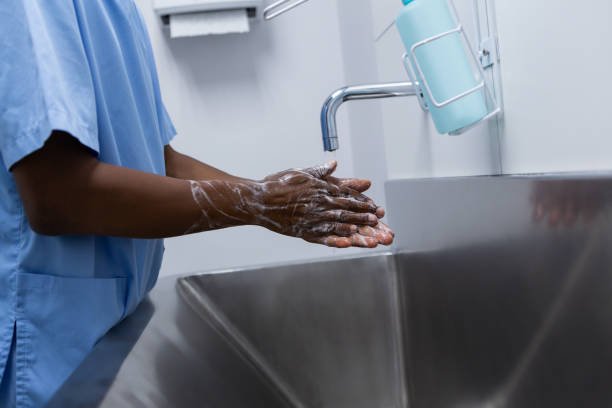
The findings on hand hygiene are also stark. Only 27% of Nigerian health care facilities met the basic hygiene standard in 2025. About 57% had limited hygiene services and 17% had no hygiene service.
That means nearly three in every four facilities fell short of the basic hygiene standard.
A facility meets the WHO/UNICEF basic hygiene standard when functional hand-hygiene facilities are available at points of care and water and soap are available at toilets.
Nigeria is also among countries where at least one in 10 health care facilities had no hygiene service, meaning hand-hygiene facilities were missing both at points of care and near toilets.
Globally, 72% of health care facilities met the basic hygiene standard in 2025, compared with 34% in sub-Saharan Africa. Nigeria’s figure of 27% is below both.
Four figures, one health-system challenge
Four figures capture the scale of the gaps identified in Nigeria. In 2025, 55% of health care facilities met the basic water standard, 29% met the basic sanitation standard and 27% met the basic hygiene standard.
For health-care waste management, the figure fell to just 5%. For patients and health workers, the figures concern some of the most basic conditions inside a hospital or clinic, whether water is available, whether toilets meet minimum requirements, whether hands can be cleaned where patients are treated and whether used needles and infectious waste are handled safely.
The medical-waste figure is particularly striking. At 5%, Nigeria’s basic waste-management coverage is far below the 24% recorded across sub-Saharan Africa and the global figure of 71%.
The report also identifies Nigeria among countries where more recent surveys have produced lower estimates for waste-management services.
WHO and UNICEF caution, however, that lower estimates do not necessarily mean services have deteriorated.
They say improved data-collection systems can reveal conditions in health facilities more accurately than earlier assessments, meaning some apparent declines may reflect better measurement rather than a sudden worsening of services.
A basic expectation of health care
Nigeria’s estimated population in the JMP country tables is about 237.5 million people.
The report does not establish that patients have been harmed as a direct result of the gaps it identifies.
But water, usable toilets, hand-hygiene facilities and the safe disposal of medical waste are among the basic services needed in facilities where people receive health care.
For Nigeria, the WHO/UNICEF assessment shows that meeting these standards remains far from universal.
