




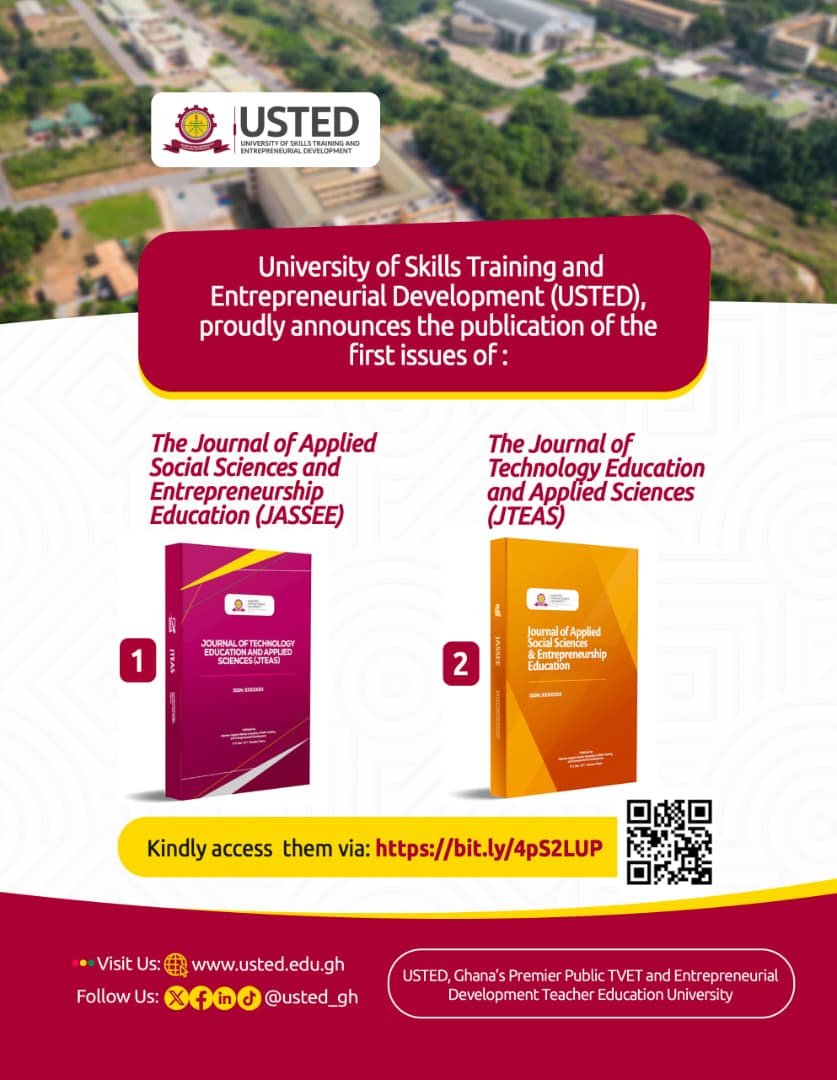
A Ghanaian public university has launched two peer-reviewed academic journals aimed at strengthening African research, increasing access to locally generated knowledge and creating new publishing opportunities for scholars across the continent.
The University of Skills Training and Entrepreneurial Development (USTED), formerly the Akenten Appiah-Menka University of Skills Training and Entrepreneurial Development (AAMUSTED), released the maiden editions of the Journal of Applied Social Sciences and Entrepreneurship Education (JASSEE) and the Journal of Technology Education and Applied Sciences (JTEAS). The launch marks the university’s formal entry into academic publishing.
The two online, peer-reviewed journals are open access, allowing researchers, students and policymakers to read published studies without subscription fees. Together, the inaugural editions contain eleven research articles by authors from Ghana, China, the United Kingdom and Finland, with every paper assigned a Crossref Digital Object Identifier (DOI) to ensure global discoverability and citation.
The publications reflect the growing role of African universities in producing research that responds to local development challenges while contributing to global knowledge.
The first editions cover a diverse range of subjects, including teacher professionalism, entrepreneurship, access to primary education, financial technology, renewable energy, artificial intelligence, industrial training, environmentally friendly wood preservation and the reuse of mine waste in construction materials.
In his editorial, the Editor-in-Chief of JTEAS, Professor Isaac Boateng, said universities should be judged not only by the graduates they produce but also by the knowledge they generate and the impact of that knowledge on society. He said the journal aims to become one of Africa’s leading publications in technology education and applied sciences by promoting rigorous and socially responsive research.
Professor Stephen Baffour Adjei, Editor-in-Chief of JASSEE, said the journal embraces a “knowledge for all” philosophy by removing publication fees for authors and eliminating paywalls for readers. He said the objective is to provide a platform for contextually grounded research that contributes to development in Ghana, Africa and beyond.
The launch comes as universities across Africa continue to seek greater visibility for research produced on the continent and stronger collaboration among scholars addressing shared challenges in education, technology, climate change, entrepreneurship and sustainable development.
By adopting an open-access model, USTED hopes to make research findings more accessible to academics, policymakers, journalists and development practitioners while strengthening international collaboration and increasing the visibility of African scholarship.
For researchers across West Africa, including Nigeria, the new journals offer an additional peer-reviewed platform for publishing evidence-based studies and contributing to knowledge that addresses regional development priorities.
